Professor, students test fitness trackers

Dr. Robert Thiebaud, a Wesleyan assistant professor of exercise science, has been conducting research on three fitness trackers to test their accuracy.

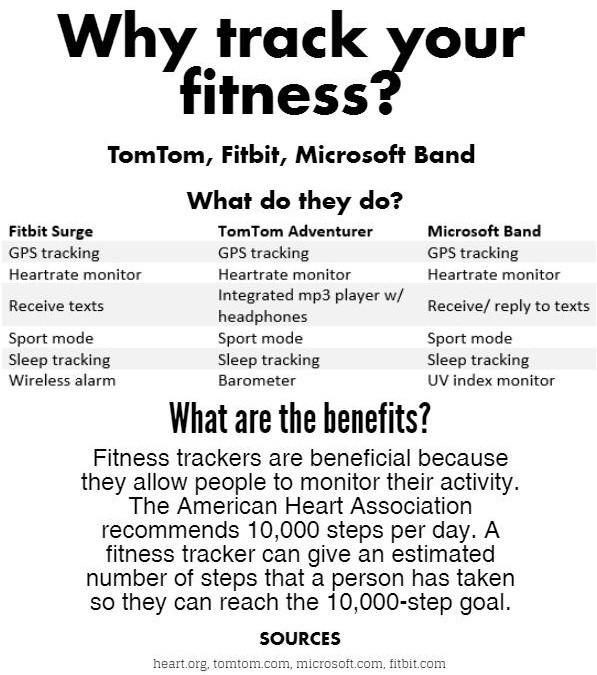
Thiebaud has been researching TomTom Adventurer, Microsoft Band, and the Fitbit Surge since the fall 2016 semester, he said.

“I remember one time in basic concepts class we were talking about tracking your physical activity,” Thiebaud said. “And you know a student brought up a question, ‘Which one is the best one to use?’ and it’s a good question. There’s been some research but I hadn’t looked much into it.”

Thiebaud is doing the research with five exercise science majors, including Jacey Patton, Martin Schmidt, Brook Massey, Terri Shay, and Alex Davis. The research will continue through the semester and the current research was presented by Massey and Patton at the regional Texas American College of Sports Medicine conference on Feb. 16 and 17 in Waco.

There is some research about the accuracy of fitness trackers but there is not a lot of substantial information out there, Thiebaud said.

“They come out with new ones all the time so quickly that we can’t keep up necessarily with how accurate they are,” Thiebaud said. “[We] can’t keep up with the technology so that was one thing, just a curiosity just to see which ones measured accurately.”

The fitness trackers being tested measure heart rate at the wrist and track energy expenditures, Thiebaud said.

“We’re still in the process of clenching data. We need some more people [to test the trackers],” Thiebaud said.

Typically heart rate monitors require a strap to be worn across the chest that can be uncomfortable while working out, Thiebaud said. A fitness tracker with a heart rate monitor at the wrist is more convenient.

“With these devices in particular we were looking at them because they can measure heart rate just by doing it at the wrist,” Thiebaud said. “So what we’ve seen so far is that they do pretty good at faster speeds.”

The study being conducted by Thiebaud and the exercise science department looks at the accuracy at 2-6 mph on a treadmill, he said.

“Just seeing how accurate they are throughout the whole duration and we’re seeing that they’re a little bit better at these faster speeds but there’s a lot more variation in these slower speeds,” Thiebaud said.

Thiebaud said that about 15 Wesleyan students, most undergrads, have participated in his experiment but he would like to test around 50 students overall.

“First, we put these [the trackers] on their wrists.  Two on one [wrist] and one on another wrist and then we hook them up to an electrocardiogram or ecg,” Thiebaud said.

The student is connected to an ecg to monitor their heart rate, which can be compared to the heart rate the tracker provides, Thiebaud said.

“Then we have another machine called the metabolic cart,” Thiebaud said. “They put basically a kind of mask on and they breathe in air and they expire their air. Then we measure how much oxygen they consumed during that exercise and from that information we can estimate how much energy they’re expending.”

The metabolic cart is used to estimate the amount of calories burned during the experiment and that number is later compared to the calorie expenditure that tracker displays, Thiebaud said.

“It’s about 15 minutes total of exercise so it’s a little bit more structured experiment,” Thiebaud said. “But sometimes you know people just aren’t always on a treadmill but for these particular ones that’s where we were.”

The experiment requires each person to wear the three trackers and the metabolic cart mask, and be hooked up to an ECG, Thiebaud said. They then walk for three minutes at 2 mph, 3 mph, 4 mph, 5 mph, and 6 mph consecutively. Their heart rate and energy expenditure is monitored once every minute during the experiment.

“We still need to get more data but the one that seems from our data right now to be the best at heartrate is going to probably be the Fitbit or the TomTom,” he said.

The Fitbit and Microsoft Band did well at calculating energy expenditure while the TomTom didn’t provide as accurate calorie data, Thiebaud said.

“Which one to buy is always the question though,” Thiebaud said. “So that’s what we’re trying to help people figure out. Once we get some more data we’ll have a better more conclusive result.”

The TomTom and Fitbit compared to the Microsoft Band are usually better at monitoring heart rate. But the Fitbit and Microsoft Band are better at calculating energy expenditures, Thiebaud said.

The five students he is doing the research with, he said, “have been a huge part of this project and I really thank them for putting in the time and effort. They’ve all been really big contributors in helping to get it figured out to collect the data so they’ve been great.”

Fitness trackers are just really convenient and it’s great that they can be worn as a watch, freshman psychology major Trudy Allen said.

“I like wearing [my tracker] for golf. Since I’m on the golf team it notifies me when I get text messages, emails and snap chats,” Allen said.

They’re fun to use and it’s exciting to see how much exercise she’s gotten in a day, Allen said.

“I use it when I’m running and golfing basically, I like it since it lets me know how far I’ve run and how active I’ve been throughout the day,” Allen said.

Allen said she likes the Apple Watch because it has a bigger face and lets her interact with her phone more than the other trackers.

Freshman criminal justice major Tyler King said the pedometer feature most trackers have motivates her to get up and moving.

“I have the fitbit charge so I’m really interested to know how accurate the Fitbit products compare to the other types of trackers,” King said.  “The Fitbit works as motivation for me to try and be healthier.”

For more information on this study go to rthiebaud@txwes.edu.
Rams named All-Academic scholars

Soccer player Michael Brown began playing for the Rams after serving in the Navy, and says that being able to play at the college level is a dream come true.

But part of being able to do that is keeping up his grades, which can be challenging, because during the season, the team practices five or six days a week and plays anywhere from one to three games per week.

Brown said he has been able to maintain his GPA by planning ahead and communicating with his teachers, most of whom have been understanding and flexible about class deadlines.

“It helps also if you do quality work in class and they know you’re capable of it then they’re going to be a little more willing to work with you because of a school obligation,” Brown said.

By maintaining at least a 3.25 GPA, Brown has become one of Wesleyan’s scholar athletes. The Sooner Athletic Conference announced the list of 2016 academic all-conference athletes on Feb. 1, and Wesleyan had 22 of the conference’s total of 199.

SAC scholar athletes must maintain a 3.25 GPA in the previous two semesters and be regulars, or letter winners, on their team, according to ramsports.net.

“It really was a great opportunity to play at the college level and at the same time earn good enough grades to receive this reward is an honor,” Brown said.

Athletic Director Steve Trachier said he is “awfully proud” of Wesleyan’s scholar athletes; the department’s goal is to have athletes do well in the classroom, create competitive professionals and earn a degree, and part of being competitive is keeping a high GPA.

“If you go back and look at the history of the athletic department over the last several years, you’ll see the number of scholar athletes that we have increasing, you’ll see the number of scholar teams we have increasing, you’ll see the athletic department GPA increasing,” Trachier said. “We are an institution of learning.”

Wesleyan’s scholar athletes for fall 2016 included nine from women’s soccer, five from men’s soccer, two from men’s cross country, one from women’s cross country, and five from volleyball, according to ramsports.net. Every scholar athlete has to balance schoolwork with practice and games, and doing so often means sacrificing sleep and free time.

Men’s soccer midfielder Kian Hosseinpour maintains his GPA because getting a work visa is very competitive and any kind of edge can help.

“I knew that playing soccer, playing a sport and a high GPA would help me in getting a visa and finding work later on,” said Hosseinpour, a sophomore finance major from New Zealand.

In season practices involve a lot of skill work and working as a team, Hosseinpour said.

“In the fall [balancing grades and soccer can be] a bit trickier because we travel so much and we’re away in Oklahoma or west Texas a lot,” he said.

Hosseinpour tries to be proactive and get his schoolwork done ahead of time in order to keep his GPA up.

“I try to do everything before I leave for trips so I can have a free mind and obviously sometimes that means staying up a bit later and you don’t have as much time to do other things,” Hosseinpour said.

Volleyball practices are two hours every day and the team plays between two and three games a week during their season, said Kiersten Mebane.

“Currently, we have fitness at 5:30 a.m. and fitness is basically just lifting weights and running,” Mebane, a criminal justice major, said. “Following fitness at 6:30 am we have volleyball practice like usually from 6:30 am to 8:00 am sometimes 6:30 to 8:40. So you’re already tired before your day even begins.”

Mebane uses whatever time she can find to get her homework done.

“When we travel is just like homework time,” Mebane said. “Homework on the bus, in the hotel room, at the game. I have written so many papers on charter busses.”

Mebane strives to make good grades because it makes her feel that she has accomplished something, and because it will make it easier to get into a reputable graduate program.

Junior accounting major and volleyball player Shelby Stinnett said that she will just grab a book for her classes during any free time she has.

Stinnett, an outside hitter, makes an effort to keep her GPA as high as possible because of the competitiveness of graduate school.

“My dad has always held me to a high standard. It does feel good to get a better grade because it makes you feel like you actually know the stuff,” Stinnett said. “[Our coach] does grade checks, so we’ll have to have our teachers sign off [on things] like ‘do we pay attention?’, ‘are we doing good in the class?’ and ‘what’s our progress?’ so she keeps us accountable for it but it’s ultimately our responsibility.”

Katie Baugh, a sophomore athletic training major and soccer player, said her dyslexia means she has to work harder to keep up her grades; being on the soccer team — which practices five times a week and plays two or three games a week — takes a lot of time.

“It’s really somewhat tough to be a college athlete and balance school,” Baugh said.

Maintaining grades is a team goal for the women’s soccer team because if one player fails it affects the whole team, Baugh said.

“It’s tough. But you do what you can for the game that you love to play basically,” Baugh said.

In order to keep good grades, the team communicates with their teachers and plans ahead so they can keep up with classwork, Baugh said.

“I study a lot on the bus. I like to sleep a lot on the bus too but I always have my computer with me,” Baugh said. “You do whatever you can, like if I have an essay due I’d type it [then] wait until we get to the hotel and then send it.”

The infographic at left shows the number of scholar athletes at all Sooner Athletic Conference schools; Wesleyan is fourth in the conference.
Infographic by Karan Muns

Rams getting ready to put on the pads

Texas Wesleyan football is gearing up — for spring practices, an intersquad scrimmage in April and, of course, the 2017 season.

The team is practicing in the afternoon Monday through Thursday and at 5 a.m. on Fridays and will start practicing in pads on March 28, said head coach Joe Prud’homme.

“[The morning workout is] to instill toughness,” Prud’homme said. “It’s got different components to it but it’s different every week. We’re trying to instill a mental toughness and physical toughness that we want to play with. We want them to understand that there are sacrifices that have to be made in order to do this. Getting up at five and being here at five and doing that workout is not easy. I don’t pretend it is.”

The team is excited to begin tackling, running plays and preparing for their scrimmage, tight end Logan Butler said.

“We are really excited about it. I mean I’m really excited about getting pads on and just start hitting. It’s like being a kid in a candy factory,” said Butler, a sophomore biochemistry major.

The team’s uniform, made by Adidas, will be revealed at a Thursday press conference.

“That’s for a lot of boosters and things of that nature want to see it first,” Prud’homme said.

The team’s intersquad scrimmage will be held at 3 p.m. on April 22 at Farrington or Clark, Prud’homme said.

The team is extremely self-motivated, Prud’homme, and the closer to pads and actual games the more excited the players are getting.

“They know pads are coming and it’s more like football,” Prud’homme said. “It’s tough to go through a year without playing and everybody else is and stay at that heightened alertness and awareness is tough.”

The 2017 season begins with an away game against McPherson College on Sept. 2; the Rams’ first home game is Sept. 9 against Millsaps College.

The season was originally going to be 10 games, but Wesleyan added a game with Oklahoma Panhandle University to the schedule. The teams play at 2 p.m. on Nov. 11 in Goodwell, Okla.

“We picked up Oklahoma Panhandle State [University] joined our conference so that was the eleventh game so it changed a little bit,” Prud’homme said.

Prud’homme and his coaching staff have been scouting the other teams in the Central States Conference.

“We went and watched them during the season,” Prud’homme said. “We saw several of them play so we got a feel for what we’re going to be competing against.”

The schedule looks good but traveling so often will be a challenge for the Rams, Prud’homme said.

“The traveling piece is going to be pretty challenging,” Prud’homme said. “We’ve got a DII on our schedule first year which I think is pretty ambitious but I feel good about it.”

Prud’homme said that running a startup program with 100 players is challenging.

“And now you add in all the factors of what all we’ve got to do to get ready for practices,” Prud’homme said. “The equipment piece, the storage of the equipment, managing our practice schedule, ‘Where are we going to be?’ ‘How are we going do it?’ and the transportation issues.”

Before the pads go on in March, the players are practicing skills within their position groups, lifting weights and running, said fullback Zack Lanham.

“We’re spending a lot of time not only relearning the skills of football as a college athlete on a new level but we are learning new skills that are really going to prepare us for that college level and how to play a position that we’ve grown up playing,” said Lanham, a criminal justice sophomore.

The team has been practicing on the mall and at the practice field across from the Law Sone Fine Arts Center, Lanham said.

“We’ve been in two places,” Lanham said. “The reason why is that the grass gets torn up because of the cleats so until we have a sufficient play to practice with turf and or more than one field in one location we’ll keep alternating.”

The team will have an 18-day period for the offense and defense to practice in pads, Lanham said.

“We will most likely be staying away from tackles on the legs stuff like that because this is just to get us back in that feel of aggression so [there will be] a lot of hits up high,” Lanham said.

The program is a lot to keep together, especially considering that the team does not have its own facilities, Prud’homme said.

“I never would have thought at the beginning of my career that I’d be doing this,” Prud’homme said. “A startup college program, but I do find it very exciting and rewarding so far. And I do believe that we’re going to have something people are proud of.”

Prud’homme wants the Rams to be a Metroplex team, not just a Fort Worth or Polytechnic or Tarrant County team.

“It’s not just this little area of Fort Worth where we’re going,” Prud’homme said. “I want it to be that everybody wants to come see us play. That’s in the back of my mind on a lot of decisions that are made.”

Above, tight end Logan Butler runs during a practice last fall. The sophomore played for head coach Joe Prud’homme at Nolan Catholic High School.
Photo by Karan Muns

Rams’ attitude leads to winning season

Texas Wesleyan’s men’s basketball team expects to excel in their upcoming games and the conference tournament because of what head coach Brennen Shingleton said is the culture of this year’s team.

“We are a new team,” Shingleton said. “We’ve got great leadership and more importantly I think this team is by far the most unselfish team I’ve been around.”

The team, which is currently ranked No. 1 in the Sooner Athletic Conference and 16th in the nation among the NAIA Division I men’s basketball teams, won five games in a row between Dec. 31 and Jan. 14.

Because the Rams lost several starters last season, returning members have really had to step up and fill leadership roles, Shingleton said.

“We’ve got Naiel Smith, [who] is the leader in the nation in the assisting game, and we’ve got guys that are scoring really well,” he said. “We’re balanced.”

Shingleton believes that his team excels at “pouncing on their opponents.”

The team takes the season week by week and really focuses on the next game in front of them, he said.

“If we keep crawling up the rankings and taking care of our business the goal is to win another conference title and go from there,” Shingleton said.

Shingleton thinks the leadership and work ethic are largely responsible for his team’s success so far this season.

“You don’t have to do a whole lot of coaching. These guys are really kind of just locked in, and they seem to be really cohesive,” Shingleton said.

Shingleton thinks the attitude of the team has changed dramatically since last season, but the players still are motivated to win games.

“The difference being with this particular group is they have an uncanny ability to want to be coached,” Shingleton said. “It’s almost as if we kind of have to taper back the amount of information that we give.”

The 2016-2017 team will practice for hours at a time and not give it a second thought, Shingleton said.

“The difference being between this group and last year’s group was last year’s group was more of a management position job,” Shingleton said. “We really had to make sure the pieces of the puzzle fit. This group the puzzle fits. Now, we’re just trying to make sure we get the most out of it.”

Shingleton believes that the team is “unselfish to a fault” and that they need more constructive criticism at practice.

“We really have to find guys to say ‘you need to do more’, ‘you need to be more assertive’, ‘you need to be more proactive’, those kind of key words, and we didn’t have that kind of problem last year,” Shingleton said.

The team has so much potential that Shingleton said he is looking to maximize the skills of each player and push them to be the best they can be.

“It’s an amazing deal because nobody’s really ball hogging,” Shingleton said. “Everybody is trying to do what’s best for the team.”

The team’s unselfish attitude is apparent to anyone and can be seen in every game they play, he said.

“It’s a little unnerving as a coach because you’re waiting for the ball to drop; you’re kind of waiting for a problem to solve and this and that and this group doesn’t have it,” he said.

Shingleton thinks it is fun to watch this team compete because of how cohesive they are and how well they work together.

“We’re still kind of gradually trying to find our break-out moment, and find out how good we can really be,” Shingleton said. “And to be honest with you I don’t think we’re really close. I think we’ve got a lot of work to do, but the good part about it is we’re winning while we do it and not losing.”

Forward Peyton Prud’homme, sophomore mass communication major, is excited to finish the season with his team leading the conference.

“We’re first in conference. We’re ranked 16 in the nation It looks like we’re going to make the tournament. I think we’re going to win it,” said Prud’homme, who is not related to Wesleyan head football coach Joe Prud’homme.

There are still plenty of opportunities to watch the Rams at home so he urges Wesleyan students to come support the team, Prud’homme said.

Prud’homme thinks that this team is exciting to watch because many players have stepped up as leaders.

“Honestly, our top eight guys really produce a lot of minutes on the court and then we have really good bench too,” Prud’homme said.

In addition to practicing for hours on end, the team has been watching films of their opponents, as well as their own films, to develop new strategies and improve their skills, Prud’homme said.

The team has been preparing for upcoming games and working hard to stay healthy for the rest of the season, Prud’homme said.

“We’ve been pretty injured lately. A lot of guys are beat up and hurt, but we haven’t really had many guys miss games,” Prud’homme said. “We’ve had a couple miss games, but for the most part we’ve just kind of been playing pretty beat up, but that’s just part of the game.”

The team has high expectations for this season and they are very driven to win another title, guard Praneeth Udumalagala\ wrote in an email.

“Our expectations are pretty straight forward and that is to win every game we play. We take it one game at a time, and eventually, we will achieve our goals of winning the conference championship and then nationals,” wrote Udumalagala, a junior business management major.

Udumalagala thinks the team’s success is due to the program’s continued excellence and motivation.

“I’m not sure if we have done anything different [this year]. Every season we do our best and our coaches prepare us. It’s nothing short than performing our best, giving our 100% everyday as a program in and out of the gym,” Udumalagala wrote.

Udumalagala believes that the season is off to a great start but it’s too soon to compare the success of last year’s team to this year’s team.

“So far it’s a great start for our season, and I’m sure that it only gets better as the team is looking good and strong,” Udumalagala said.

Senior guard Naiel Smith, a liberal studies major, makes a 3-point basket at Wesleyan’s game against Bacone College.
Photo by Karan Muns

Wesleyan adds men’s tennis

Texas Wesleyan’s men’s tennis team will begin playing in the fall of 2017, Athletic Director Steven Trachier said.

Angel Martinez, the head women’s tennis coach, will also coach the men’s team next fall, Trachier said.

“We are hiring an assistant coach to help him with the program as numbers increase, and that kind of stuff,” Trachier said.

The men’s program should be an easy addition because there is already a coach, a facility, and a budget in place, Trachier said.

Wesleyan’s women’s tennis team began playing in the fall of 2015 after a 13-year hiatus, according to ramsports.net. Martinez was named the 2015-2016 United States Professional Tennis Association Texas College Coach of the Year.

“Coach Martinez signed his first recruit [Mace Brasher] a few days ago, who is actually the brother of one of his current players,” Trachier said. “That’s the first recruit and he’s been talking to many more. It should build pretty quickly.”

Tennis is a fall and spring sport but the championship events occur in the spring, he said.

“You play your regional tournament, and if you qualify you go to nationals in the spring, but they’ll be competing in the fall against other colleges,” Trachier said.

The tennis facility, Arlington Tennis Center, has enough courts for the men and women to practice at the same time, he said.

“Right now, we are in an unaffiliated grouping,” Trachier said. “Basically, in the Sooner Athletic Conference there aren’t enough teams that play tennis to have a tennis conference, so we co-op with two other athletic conferences to form what is called an unaffiliated group, and that’s what we’ll play in.”

The new men’s team will be able to advance in the NAIA quickly since the area around Wesleyan has a lot of good high school tennis programs, he said.

“That demographic, historically, are good students. They’re good in the classroom. I think that it will help us academically and athletically,” Trachier said.

More opportunities available to continue athletics at Wesleyan should help the university academically as well, he said.

“I like it when our athletic teams are growing at a time when the university is growing. It’ll help our retention,” Trachier said.   

It’s a great thing to have a men’s team as well as a women’s team because the teams can cheer each other on, tennis player Loli Garcia said.  

“It’s good for the school when recruiting new players. The men’s tennis team will make us more well-known, it will make it easier for us to bring new people to the school,” Garcia, a senior business management major said.

The two teams can help encourage one another by being loud at matches and motivating one another, she said.

“I might not be here playing then, but I am excited,” Garcia said. “I’m excited to see how everything is going to be.”

Wesleyan tennis player Maggie Brasher, the sister of Mace Brasher, the men’s team’s first recruit, said her brother is “a great player and a great kid.”

A new program allows players that might not have had the chance to play college tennis elsewhere a chance to continue their tennis careers, she said.

“I think that he just wanted to be close to home,” she said of Mace. “ That’s a good advantage of having a small team or small school that is close to where we live.”

The siblings’ relationship is very close and may have played a factor in where Mace chose to go to college, she said.

“I don’t like to say that I played a factor, but we’re really close, so I think that it may have helped us to go to the same school together,” she said.

It’s a unique opportunity to be a player on a new team because it’s an opportunity to create a name for the program, she said.

“Well, since I was the first signing for the women’s tennis team,” Brasher said. “I told him that it was not always a bad thing to start fresh from a team that has nothing.”

Brasher was surprised to hear that the university was adding a men’s team because at the time of her signing it didn’t seem like a possibility.

“I think it’s a great opportunity for anyone. It’ll be fun,” she said. “It’ll make the women’s team more dynamic, it’ll be fun to have a good mix of guys and girls.”

The addition of men’s tennis, football, and lacrosse should help make the school more visible, she said.

“It’s going to be a good learning experience for everyone,” she said.

Angel Martinez will coach both the men’s and women’s tennis teams.
Photo by Little Joe.

Rams anticipate another SAC victory

Head coach Brennen Shingleton and his players agree: the men’s basketball team is preparing to have a great season.

“Our guys that are returning are great leaders on and off the court, they are doing a fantastic job of getting us in position to be successful,” Shingleton said. “I couldn’t be more proud of where we are at right now and really excited to get the season going.”

Last season, the Rams posted a 24-8 (14-4 conference) record on the way to winning the Sooner Athletic Conference; the team lost to Campbellsville University in the first round of the NAIA Division I playoffs in March.

Even though it was an impressive season, the Rams are looking to do even better this time.

“We are looking at one game at a time and expect to win the conference championship first and then nationals. We have everything we need to win,” said guard Praneeth Udumalagala, a junior business management major.  “Just like every other year, we as a team do our best to get ready for the season.”

The team lifts weights, conditions, and works on offense and defense during their six practices a week, Udumalagala said.

“More than half our players are new this year,” Udumalagala said. “Every player on our team is super excited for the opportunity they have received.”

Each athlete has been working hard to make sure they have what it takes to win, Udumalagala said.

“Every [player] is hungry to win and they are super excited for the season to show their talents and more importantly to show our team’s strength and to bring honor to our school by winning,” Udumalagala said.

A basketball program like Wesleyan’s is hard to find since there aren’t many like it, Udumalagala said.

“This program is special; from coaching staff to all the players entering, this program has the discipline to work as one to achieve our goals,” he said.

Achieving goals can be difficult but taking the season one day at a time helps, said point guard Patrick Listach, a senior history major.

“Every day brings a different challenge but we, the team and coaches, attack each day with intensity mentally and physically,” Listach said.

The whole team knows that it will take hard work to win games, Listach said.

“Nothing comes easy and we all understand that,” he said. “I think that is what will separate us from any other team in the country; all 15 guys want it and we’re willing to give it everything we have every day.”

Listach believes that the attitude the team had last year is here to stay.

“I believe we are very similar to last year’s team as far as work ethic,” Listach said. “We love to compete. We love to play the game of basketball.”

Out of the four years that Listach has been at Wesleyan, he hasn’t played with a team quite like this one, he said.

“We play really well together, we learn quickly, and we are fast and very athletic,” Listach said. “It will be a very exciting season for sure.”

The way that the team practices is going to make beating them a difficult task, Listach said.

“We are going to be tough to beat,” Listach said. “Coach Shingleton and coach Garnett have prepared us every day of practice and the guys are really buying into the system. Like we say in practice, ‘We’re ALL IN.’”

Wesleyan offers more than just a great basketball program. It also offers a great challenging learning environment, Listach said.

“Texas Wesleyan offers more than I could have imagined,” Listach said. “I love my professors and I love the curriculum. Also, I love playing for coach Shingleton. He knows how to get the best out of me.”

Wesleyan’s basketball program and the courses offered allow people to grow from their experiences here, Listach said.

“When I graduate I know I’ll be a better person than I was when I first came to Wesleyan,” Listach said.

The team bases its practices around the principle aspects of basketball, Shingleton said.

“We defend as a team, rebound, share the ball and get in the best physical shape of our lives,” Shingleton said. “But more importantly, we are building a chemistry and accountability as a team that doesn’t waiver.”

The team created its own work ethic, Shingleton said. The players decided that they needed to work hard.

“This group has been unbelievable,” Shingleton said. “Our coaching staff hasn’t had to ask them to work hard. We have GREAT leadership.”

There really isn’t any comparison between last year’s team and this year’s because they are different teams, Shingleton said.

“This team has its own challenges and goals,” he said. “We appreciate the past success but we are focused on new goals and challenges.”

The team lost a lot of players but they have also gained a lot of new players, Shingleton said.

“It’s never easy replacing any players, but the challenge is maintaining the culture of our program,” Shingleton said.

The men’s basketball team’s first home game is Oct. 31, when they play Dallas Christian College. Game time is 7 p.m. Tickets are $5 but admission is free for children under 12 and anyone with a Wesleyan ID.

Junior guard Jalil Francois, senior guard Najeal Young, and senior guard Naiel Smith wait outside the gym in Sid Richardson for team pictures.
Photo by Karan Muns

Lady Rams fight for a better season

Last season, the Lady Rams were hobbled by injuries to several players, and they paid the price.

The team finished 8-21 and finished at the bottom of the Sooner Athletic Conference.

This season, the team hopes to stay injury free, improve their record and go into postseason play.

“The team is looking good and working hard,” Franey said. “Barring injuries this is a team that can advance to the national tournament and do well. The team will have to fight hard every game.”

Katelynn Threats is the only two-time all-American at Wesleyan and she will be returning for her senior year, Franey said.

“If it is our turn to part the water she will be our Moses,” Franey said.

The team is working hard in practice and learning to build trust and chemistry, he said.

“This is the kind of unselfish team that is fun to coach,” Franey said.

The team lost a few players, some of whom will be hard to replace, Franey said.

“Onyesonam Nolisa was one of the best players in school history,”Franey said. “She will be impossible to replace.” Franey said.

Practice is where all the groundwork for the team is created and planned out, Franey said.

The team has been working hard in and out of practice to get to know each other and create chemistry, Threats said.

She sees a difference between last year’s team and this year’s: this year everyone is working toward being successful and creating a winning season.

“This is shown in things like there work ethic in practice, not being selfish and they uplift one another because at the end of the day it takes a whole team to be successful,” Threats said.

Threats believes that the team could be more successful than last season if everyone can remain healthy and get to know how each member operates.

“We’ve got quite a few girls this year,” Threats said, “and they all are fighting hard for their position on the court as well as making the next girl better so that we can be successful.”

Threats is excited to begin playing this season and finish out her career at Wesleyan.

“I’m more excited to possibly do something that has never been done during my time here and that’s go all the way,” Threats said.

Threats gives some of the credit to Franey for believing in her and pushing her limits.

“I am very fortunate enough to have been given the opportunity by Bill Franey who saw something in me that I didn’t see in myself,” Threats said.

The team has been practicing and scrimmaging each other every day for more than a month, said  Falesha Fuller, a sophomore exercise science major.

“Scrimmaging each other is allowing us to learn about each other and find the chemistry needed in order to play well as a group,” she said.

The team seems different this year, Fuller said. It’s more relaxed but everyone is still focused on winning.

“We’re able to make jokes and laugh while practicing and working hard,” Fuller said. “Everyone is positive and has that drive to win.”

The team gained quite a few players, so this team is bigger than last year’s, Fuller said.

“I expect a lot more wins this year because we have too much talent to not win,” Fuller said. “We will definitely be a team to fear and watch out for.”

The team has been preparing for the upcoming season by conditioning to prevent injuries, said Angela Nguyen, a senior business management major.

“We have been playing more full-court play between one another to help us get to know one another as well as allow us to work a lot on full-court offense and defense,” Nguyen said.

The 2016-2017 team has about half a dozen new players, and they bring a new level of excitement to the team, Nguyen said.

“This year’s team finds motivation within one another to make sure that everyone on the team is on the same page,” Nguyen said. “The work ethic is a lot better than it has been because we as a team know how to pick one another up.”

Nguyen thinks the Lady Rams could go far because of the experience the returning players have and the fact that everyone is healthy.

“I think we could be in the top four of our conference,” Nguyen said.

The team is anxious to begin the season and hopes that everyone can remain healthy this year, said Leah Taylor, a junior psychology major.

“Last year we started off really good but had some injuries,” Taylor said.

Basketball is a demanding sport and playing with a limited number of players due to injuries hinders the team, Taylor said.

“This year everyone is healthy and we are practicing harder than ever,” Taylor said.

The team reloaded its roster and is ready to start playing games she said.

“We have some new players and they are really good alongside our veterans,” she said.

The support of teammates is great but it isn’t the same as having a large crowd at games, Taylor said.

“We have great team bonding,” Taylor said. “We support and encourage one another.  We would love to see our school support us and cheer us on.  Let’s go Rams!”

The Lady Rams’ first home game is Nov. 23 against East Texas Baptist University. Game time is 6 p.m. The team will play Texas Christian University in an exhibition game at TCU at 5 p.m. on Nov. 8. Tickets are $5 but admission is free for children under 12 and anyone with a Wesleyan ID.

Lady Rams head coach Bill Franey coaches players Lauren Benjamin (with the ball), Courtney Chargois (far left), and Leah Taylor (blue jersey).
Photo by Karan Muns

Slabach names engaging educators and staff hero

Texas Wesleyan President Frederick Slabach said on Tuesday that the university’s faculty and staff really bring the Smaller. Smarter. promise to fruition.

Speaking at a 2020 Town Hall meeting during free period at the Baker Building, Slabach showed videos of himself popping in on professors and presenting them with popcorn and their Engaging Educator Award.

“What we’ve been doing is sort of identifying educators who have gone above and beyond and we actually go into their classroom and present them with the Engaging Educator Award,” he said.

“[Engaging educators] blaze trails for the next generation of critical thinkers to follow, both inside the classroom and within the professional community,” according to txwes.edu.

Some of the “pop-in” videos included head women’s soccer coach Josh Gibbs; Dr. Michael Ellison, professor of counseling and director of graduate counseling; Dr. Michelle Payne, associate professor of political science; Dr. Joe Dryden, associate professor of education;  Dr. Patsy Robles-Goodwin, professor of education;  Dr. Rodney Erakovich, associate professor of public administration and management; and professor of music Julie McCoy.

Slabach also presented the Staff Hero Award to Lisa Hammonds, director of CETL. This award recognizes a staff member that goes above and beyond expectations, Slabach said.

Hammonds was awarded the Staff Hero Award because of her dedication to incorporating technology into the classroom and helping colleagues incorporate technology, Slabach said.

Slabach also announced updates on the 2020 Strategic Plan. The enrollment goal was changed from 1,800 full-time undergraduate students to 2,000 since the university surpassed that goal this fall.

Slabach also said that one of the major goals of the plan is to upgrade the facilities on campus.

Some of the improvements mentioned were made in the gym at the Sid W. Richardson Center; the Oneal-Sells Administration Building; the Student Life Center in Brown-Lupton Campus Center; the O.C. Armstrong and Elizabeth Means residence halls; the Armstrong-Mabee Business Center; and various environmental upgrades.

Provost & Senior Vice President Allen Henderson, Ph.D. made a presentation outlining the major parts of Goal 1 of the strategic plan, which according to txwes.edu is “to achieve high-quality academic, pre-professional, liberal arts, undergraduate and graduate professional programs.”

“I do believe our faculty are our greatest assets. Our staff is wonderful too we know how much the students rely on you all as well,” Henderson said.

The IDEA survey that the students take at the end of the year reflects the quality of staff at Wesleyan, Henderson said. Wesleyan has gotten approval ratings in the 60 percentile the last five years, which is very difficult to do.

“Our goal is to reach 80 percent although the people at IDEA tell me that is almost impossible because anything from about 60 percent up to about 78 percent is the highest they have ever seen,” Henderson said.

Another goal in the 2020 plan is to increase the diversity of faculty and staff so that it reflects the diversity seen around and on campus, Henderson said.

The last goal, Henderson said, is increasing the number of hybrid and online courses offered to better fit the needs of commuter students.

“The goal is to get to 10-15 percent of all classes will be hybrid and online, and establish three online programs,” Henderson said.

Henderson hopes that in 2017, Wesleyan will offer an online MBA program.

“The attempt is to continue improve what we’re doing for students inside and out of the classroom,” Henderson said.

Stella Russell Hall director Jeremy Hunt said he thought the goals were “very eye-opening.”

“It was great to be informed on what is going on around the campus,” Hunt said.

Hunt said one of his favorite things about Wesleyan is the way the university is always thinking about making the student experience great.

Wesleyan started conducting a survey at the beginning of the school year about student engagement, Hunt said.

“I’m really excited to see a much grander scale of measurements, so that we can see how we are engaging with students, how students are really understanding their impact, and how they can grow and develop as young individuals,” Hunt said.

President Frederick Slabach discusses the university’s 2020 Strategic Plan during Tuesday’s town hall meeting.
Photo by Karan Muns

Room for all Rams in new weight room

Texas Wesleyan’s athletes are enjoying all the extra space the new weight room provides, Athletic Department Director Steve Trachier said.

“The university is growing,” Trachier said, “the athletic department is growing, and it’s getting better for all of us. I like where we’re heading right now.”

The athletic program at Wesleyan had already outgrown the old weight room that was located upstairs in the Sid W. Richardson Center, Trachier said.

The department and the university looked for an existing building on campus that would be large enough to turn into a functional weight room for the rapidly expanding athletic program, he said.

“We knew that with adding football, women’s lacrosse, and men’s tennis that we had to expand our facilities,” Trachier said. “The only space large enough that we might be able to retrofit to become a weight room was that snack shop area” in the Brown-Lupton Student Center, he said.

GrilleWorks had been moved to the west side of campus to the Baker Building in previous years for various reasons and it worked well so it was moved for the weight room, Trachier said.

“[This] allowed the opportunity to retrofit that facility for the new weight room. [We were] trying to use existing facilities to support our programs,” Trachier said.

Construction began in the upstairs loft area of Brown-Lupton in the spring of 2016 while food was still being served downstairs in the same area.

“They started work upstairs,” Trachier said, “to make sure that those areas were wired for internet so that our football coaches could work out of those offices, then they started working on that loft area to create meeting space for athletes up there.”

Trachier thinks that the original plan was to have the weight room ready to use in the summer before the volleyball and soccer teams got to campus to begin practicing.

“The flooring company had to come in and put the flooring in before the weights could be put in, so we were running several weeks behind, but I want to say by Labor Day weekend we were ready to go,” he said.

Everyone that has learned anything about general health and athletics know that weightlifting is extremely beneficial, he said.

“It lends to muscular strength that protects the joints better,” Trachier said. “Obviously, it improves your performance during the activity and the sport.”

Trachier expects to see nearly all of the sports teams using the new facility, but that there will be a select few that might not use it as frequently.

“Some [teams] are a little more seasonal than others,” Trachier said. “Right now the soccer teams are in season, but they’re going to start their conditioning stuff from when the season ends on into the spring.”

Trachier believes that almost all athletes will use the new space because it is more efficient than the old weight room.

“We’ve needed a large space with a lot of weights and stations that can accommodate a lot of students at one time,” Trachier said.

Most student athletes thinking of coming to Wesleyan want to see the dorms, the cafeteria, and the other facilities available to them, Trachier said, “and absolutely when you can walk them into that beautiful facility that is a selling point.”

Defensive coordinator Paul Duckworth and linebacker coach Michael Rosas worked with Richardson’s Rogers Equipment Company to create the weight room, head football coach Joe Prud’homme said.

“I think they are very pleased with how it all turned out,” Prud’homme said.

The weight room is where most of the football team’s work occurs, Prud’homme said.

“We are in there four days a week,” Prud’homme said. “It’s our number one training tool, because we don’t really have a field to go to. It’s the most important thing we have right now.”

In order to keep from wasting valuable practice time the team is split in two sections for practice, Prud’homme said.

“We go half at a time,” he said. “That way half can do outside work, agility work, speed work, and the other half can work out, and then we flip flop.”

Prud’homme expects the weight room to be instrumental in getting players to come play for Wesleyan.

“I think the weight room, how well designed it is, how functional it is, and it looks good too, is a definite recruiting tool for us, no question about it,” Prud’homme said.

The weight room wasn’t built just for the football team; it is supposed to help all the teams improve, Prud’homme said.

“We’re real proud of it we think it’s going to be a great addition for all the sports programs,” Prud’homme said. “They’re already starting to use it and get a great feel for it.”

Strength training is an important part of every football program and every sport program, Prud’homme said.

“I think all championships start in the weight room,” Prud’homme said.

The weight room is a great tool for the football team to use to develop and build as a team, said tight end Logan Butler, a biochemistry sophomore.

“I lift basically so I can be strong enough to protect the quarterbacks,” he said. “We lift because it makes us stronger and keeps us healthy to play.”

Butler is excited to continue lifting in the weight room because it is such a nice facility.

“I love the new weight room,” Butler said. “I told coach Prud’homme it’s like Christmas. It’s really amazing.”

The new weight room is beautiful but it is functional and meets the team’s needs as well, Butler said.

“The new weight room meets all of the needs we have so that our team can meet our goals,” he said. “It’s great for conditioning and getting bigger and stronger.”

Freshman offensive and defensive lineman Logan McGee squats during the football team’s practice in the new weight room.
Photo by Karan Muns

Rams work hard in the off-season

Athletic Director Steve Trachier and Texas Wesleyan athletes agree: off-season practices prepare Rams and Lady Rams for their games.

“Off-season training is critical for all sports,” Trachier wrote in an email. “It is an opportunity to increase strength, power, speed in preparation for the following season.”

Trachier believes that working out during the off-season is beneficial to the mental and physical health of all the athletes.

“Constant conditioning equates to constant wellness,” Trachier wrote. “People who condition are less likely to be ill and are generally less stressed than those who don’t condition.”

Rams pitcher Steven Frederick, a sophomore exercise science major, also thinks that off-season is the best time to build stamina and prevent injury.

“It keeps your endurance up, so whenever you’re having to go through multiple games in a week, or even in a few days, it keeps your arm and your whole body healthy,” Frederick said.

Conditioning in the off-season is mainly about getting in shape, while practices during the season are about perfecting skills and getting reps in for the upcoming game, Frederick said.

“Off-season is mainly to make sure we are [physically] prepared for regular season,” Frederick said, “so we can have less lengthy practices and focus on our games rather than having to focus on practice and getting in shape.”

The baseball program tries to make the most out of off-season practices for the players, Frederick said.

“We practice five times a week usually, sometimes six times a week, and then we practice from two to about five or six,” Frederick said. “We go in and get as much work done as we can in the time that we have and then we leave.”

Frederick thinks that the goal for most sports during the off-season is to prepare for next season’s games.

“Our off-season practices are more running intensive than our regular season,” Frederick said, “mainly because our regular season is more making sure we are prepared for the game that we’re about to play rather than conditioning ourselves.”

Head coach Mike Jeffcoat expects the players to keep perfecting their skills over the summer Frederick said.

“[Our coach] doesn’t care what we do for summer ball as long as we are playing competitive baseball so we can keep getting better,” Frederick said.

Volleyball player Kiersten Mebane thinks that volleyball’s main goal in the off-season is to perfect fundamentals and endurance.

“The reason for an off-season is to be prepared for the upcoming season and to get you in a good work ethic mode before the summertime,” the junior psychology major said.

During the summer volleyball head coach Kimberly Weaver still expects them to condition and work out over the break, Mebane said.

“[Our coach expects us] to stick to the work out plan that our strength and conditioning coach gives us, eat healthy, and make sure we are touching a volleyball any opportunity we get,” Mebane said.

A lot of the things that volleyball does in off-season is to help guarantee that the athletes are healthy and ready to work next season, she said.

“We work on strength and basics,” Mebane said, “and when you break down fundamentals you know how to do things to the point where you won’t get hurt.”

The volleyball team practices and works out every Monday, Wednesday and Friday during the off-season, Mebane said.

“We also have things we do outside of practice,” Mebane said. “We swim and have jump workouts and beach workouts.”

Mebane thinks most sports on campus work on things like the basic aspects of their sport, conditioning, and strength training so they can be ready for their seasons.

“Off-season is when you break down the skills and you focus on more individual things and more positional things as well,” Mebane said. “Whereas in-season it’s all about putting it together and playing as a team.”

Rams first baseman Josh Mender plays in a scrimmage with Richland College on Sept. 24. The Team is playing several exhibition games this fall.
Photo by Karan Muns